

 When I signed with my literary agent, one of the perks that didn’t immediately spring to mind was connecting with a handful of my agent siblings (aka fellow authors you happen to share an agent with).
While we’ve been in touch for a few months now, I feel like I’ve known today’s featured author, Monica Comas, so much longer. She is such a delight—thoughtful, funny, encouraging, wise, and a fellow food lover.
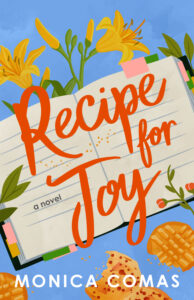
Incidentally, these are all qualities that could describe her upcoming debut novel, Recipe for Joy (Lake Union).
While this is the point where I’d normally drop a few plot details, it’s far more exciting to let Monica share what inspired her story. Plus, you’ll get an inside look at her publication journey, meet the tiny detective who keeps her company as she puts pen to paper, and discover the first books that made her crazy about reading.
Christa Banister: Considering the nonstop barrage of bad news every day, the title of your novel evokes such hopefulness. How did the story first take shape and how did you know this narrative was a keeper—the one you had to see all the way through?
Monica Comas: Thank you so much for saying that! We can all use a little more joy these days, right? I’m hoping my book will offer readers a respite from the news, a bit of escapism, because I think the special kinds of pauses that books offer really do fill our cups in the best way.
So, the kernel of this story is one I’d been mulling over for years. Recipe for Joy isn’t the first book I’ve written, but I think a magical alchemy sparked with its writing. I actually started the book still reeling from grief after my sweet mom passed away. I couldn’t return to any of my other projects I was revising—getting back to the usual writing business felt impossible. I’d started journaling longhand just trying to get back to the page. And somewhere in the middle of writing everything that was bubbling up, I realized there were emotional truths that dovetailed into this kernel of a story that had been lodged in my head. This was the one idea that felt accessible, and somewhere along the way, things became story-shaped. My mom is threaded through multiple characters in this story. It’s a love letter to her and to the charming town we lived in while we took care of her.
Christa: So many of my readers are innately curious about the traditional publishing journey. Would you be willing to share a little about yours? Querying, landing agent representation, the big call with a book deal. Was the process different than you expected during any particular juncture?
Monica:Of course! I think it’s important to share these stories because it shows how many different paths there are. For me, being an author was a dream second career. I was a journalist then a financial editor, and while working at my day job, I started getting up early to write before work. Then I transitioned to freelance editing, focusing on financial writing, so I could devote more time to my fiction.
My agent who sold Recipe for Joy is actually my second literary agent—this isn’t uncommon. My first agent, who’s lovely and still a friend, ended up focusing on nonfiction and transitioned her representation as such, so I had to get another agent.
I do believe that things—even things in publishing—work out how they’re supposed to. Because my agent now, Mark Gottlieb at Trident Media Group, was instantly taken with Recipe for Joy. At the time, other agents had partials or fulls of the manuscript, but Mark’s decisiveness really struck me. That’s the kind of agent you want championing your book—someone who’s decisive, supports stories (and their authors!), and takes action. Mark is all of that. He took my book out on submission and two months later we had a deal, which I realize is really quick.
Luck and timing play an enormous role in this process, but having an advocate who works tirelessly, as Mark does, always helps. I think what surprised me about the process was that when things started happening, they *started happening.* As writers, we work for so long with minuscule movement on every front (queries, manuscripts, etc.), so to have things actually move forward meaningfully, it was completely shocking. But I mean, the best shock ever.
Christa: There are strong family dynamics at play in your story that are incredibly relatable. Estranged sisters. The loss of a beloved grandmother. What do you hope readers take away from spending time with Belle, Lexie, and Gran?
Monica: This is always a tricky question, because you want readers to take hold of the impression that resonates most with them. Reading a book is such a personal experience, right?
So, to answer this from the 60,000-foot view, I would say that when the story is complete, after readers have spent time with Belle, Lexie, Gran, and the rest of these characters, I hope they feel lighter.
My wish is that they feel hopeful and that the novel offers them a glimmer of joy. Recipe for Joy was actually born out of grief…but also from an enormous amount of love. Life has both, right? And we have to hold it all. But there can be joy in the holding. There can be joy in this journey we’re all on, no matter how dark it gets.
Christa: Gran’s cookbook almost becomes a character in the story, do you have time-honored family recipes that are a must at holiday celebrations and get-togethers? How did your love of cooking and baking begin?
Monica: I have cherished family recipes that I make every year, which hold such special memories for me. First, my grandmother’s stuffing, which is outrageously delicious. She used to make it every Thanksgiving and Christmas, and after she passed away no one in the family knew how to make it, so I set out to figure out the recipe. Happily, after countless batches, I did and now I’m the one who makes stuffing every year. It’s a tradition and a tether.
Second, I bake my mom’s pecan tassies. When I was a kid, she used to bake these at Christmas—but I don’t mean a single batch. She would make like 10 batches and give them out to all her friends. My mom’s heart was enormous…and so I love carrying on her tradition. It’s funny though—my sister and I always joke that cooking skipped a generation in our family because our mom didn’t actually love it. But our grandmother, our mom’s mom (she of the famous stuffing) was an incredible cook. And I know you can relate to this: She used to read cookbooks for enjoyment (something else she passed down to my sister and me). So, my sister and I grew up “helping” our grandmother in the kitchen. We were never much help, of course, but that intense interest in making good food stuck with both of us. To this day, we both love to cook—especially if we can do it together.
Christa: We share a journalistic background along with writing fiction. What kind of reporting have you done over the years? How have those experiences informed your fiction (or maybe they didn’t)?
Monica: While in graduate school, I did a small stint at Saveur magazine because I was a foodie (still am) and loved magazines (still do). But I quickly learned that you really don’t write much on staff at a glossy mag, so I kind of did the unthinkable and left this great job at a cool office in SoHo to move to a tiny town in South Jersey for a local news reporting job (think, school boards, city councils, features).
But the bulk of my career after that was as a financial journalist and then I worked as a financial editor/ghostwriter for economists and investment strategists. So, to answer your question, none of my past experience directly translates to writing book club fiction! But I think every experience we have informs our writing. As writers, we’re observers, particularly of people, and being able to pull from a large pool of experience benefits our work. As you well know, being a reporter, you learn to listen, not just to the words someone is saying, but to the subtext as well. You have to piece together stories—or sometimes untangle them. I think being a journalist is such a terrific foundation for an author.
Christa: Where can our readers connect with you online?
Monica: On my website you can find links to all my socials. There’s a place where you can email me, sign up for my newsletter, which I promise won’t clog anyone’s inbox, it’s just a monthly kiss of joy. My blog and essays also live there. It’s a one-stop connection shop! I’m most active on Instagram, but am reachable all over the place, so by all means, drop a line hello!
Christa: Thank you SO much for doing this interview! 😊
And now for the Banister Questionnaire…
What’s the first book that made you crazy about reading? I actually think it was my mom reading to my sister and me when we were little that made me love books. Those included all the Beatrix Potter books, Frog and Toad Are Friends, Chicken Soup With Rice, Where the Wild Things Are, Cat in the Hat. I could go on. Also, my mom taking us to the library was formative. Sitting in those tiny kid chairs, being so excited to check out a giant stack of books, then reading them at home. My mom gave us beautiful reading memories. Also, the Scholastic Book Fair bears mention. My TBR pile today can be traced back to the Center School Scholastic Book Fair in the 1970s.
Characters or plot? Characters, always characters.
What authors’ books do you always buy no matter what the story is about? This list is long, and doesn’t include everyone…deep breath: Ann Leary, Meg Wolitzer, Jennifer Weiner, Karen Dukess, Carol Goodman, Laura Dave, Jonathan Tropper, Flynn Berry, Ava Glass, Ella Berman, Cynthia D’Aprix Sweeney, Coco Mellors, Alex Michaelides, Elizabeth Stroud, Ann Patchett, Karen Cleveland, Katie Crouch, Mona Awad, Alyson Richman, and Jess Walter.
Are you a plotter or a pantser and why does that method work for you? I’m such a pantser, I wish I were more of a plotter! I like to start with characters and a situation and pants around for a good while that way. Thing is, that will only take you so far and then I need to bring plot into the conversation. And plot, frankly, is usually cranky about being consulted so late in the process, so I’m not sure I have the best approach, quite honestly. It’s messy and reliant on lots and lots of revisions. But here we are. This is my imperfect process that I don’t expect will change.
Actual book, digital download, or audiobook? All! I read actual books in the evenings and on the weekends. I read on my Kindle before bed. And listen to audiobooks when driving or walking.
What’s your favorite bookstore? Location, please. I have so many! But I’m going to say Bedford Books in Bedford, NY. This is an absolute charmer of a store that always has the best titles. It’s also community-focused in the most lovely way. I love to go there whenever I get out of the city.
Describe your ideal writing environment. I have my laptop, my planner, my pens, my pup, a cappuccino…and it’s quiet.
Coffee or tea? Coffee!
What’s your favorite way to procrastinate when you should be writing but don’t feel like it? Cooking.
What are you working on at the moment? A novel about adult siblings returning home during one stormy week in the summer, how emotions, memories, and resentments rear up—and what a family has to do to see its way through.
Want to know more about Recipe for Joy, which hit your favorite bookstore Tuesday, March 24th? Check out this link and be sure to preorder your copy. And if you’ve ever found yourself wondering why preorders are so important to authors, this article breaks it down really well.
As an added bit of joy to close out our interview, let me introduce you to Poirot. He’s the aforementioned  pup who is an essential component of Monica’s ideal writing environment. Plus, this miniature detective is so much fun in her Instagram feed.


I’m so grateful for this interview. It was such a delight–like you! Thank you! 💖✨💖
Wonderful interview, Monica seems like a phenomenal, soulful, sweet, talented person.